Scheduling at Scale
AI-enhanced solutions for production scheduling with optimality guarantees
Freight Transportation Network Optimization
Data-driven, middle-mile load consolidation and flow planning across inbound and outbound freight networks
E-commerce Order Fulfillment Under Uncertainty
Distributional forecasts and robust optimization for sourcing, shipping, and consolidation decisions
End-to-End Supply Chains
Building efficient, resilient, trustworthy, and sustainable solutions using AI and optimization
Methodology
Exact Optimization
Column generation and Benders decomposition for provably optimal solutions at scale
Learning-Based Methods
Transformer-based models, supervised learning, reinforcement learning
Uncertainty Quantification and Modeling
Conformal prediction, stochastic and robust optimization for modeling under uncertainty
Scheduling at Scale
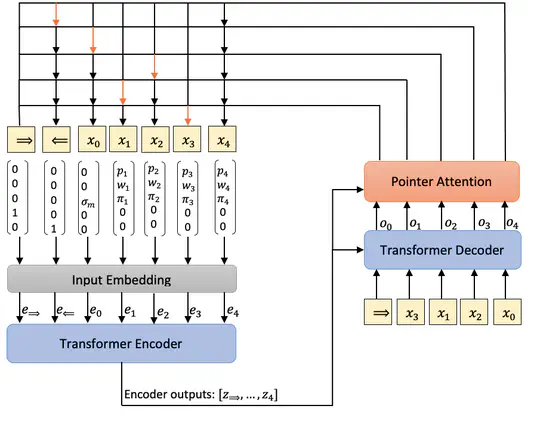
This paper addresses a key computational bottleneck in column generation, namely the repeated solution of pricing subproblems. We develop a pointer transformer model (CG NN-DP) to generate new columns in each iteration of the CG for minimizing the total weighted completion time of a set of jobs on unrelated parallel machines. The proposed approach leverages a learned optimization proxy to rapidly approximate the solution of the NP-hard single-machine scheduling pricing subproblem. Computational experiments demonstrate that CG NN-DP significantly achieves faster convergence than traditional column generation with DP. We also compare CG NN-DP with a CG procedure using an efficient pricing heuristic. For medium-sized instances, both methods yield improvements of 65% to 90% over traditional CG, while CG NN-DP outperforms CG Heuristic-DP as the number of jobs increases.
Freight Transportation Network Optimization
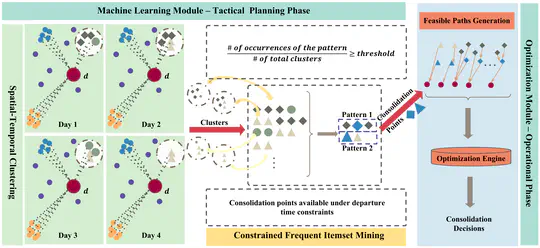
This work proposes SPOT, an end-to-end approach that integrates the benefits of machine learning (ML) and optimization for load consolidation. The ML component plays a key role in the planning phase by identifying the consolidation points through spatio-temporal clustering and constrained frequent itemset mining, while the optimization selects the most cost effective feasible consolidation routes for a given operational day. Extensive experiments conducted on industrial load data demonstrate that SPOT significantly reduces travel distance and transportation costs (by about 50% on large terminals) compared to the existing industry-standard load planning strategy and a neighborhood-based heuristic. Moreover, the ML component provides valuable tactical-level insights by identifying frequently recurring consolidation opportunities that guide proactive planning. In addition, SPOT is computationally efficient and can be easily scaled to accommodate large transportation networks. The conference acceptance rate was 13%.
E-commerce Order Fulfillment Under Uncertainty
This paper introduces a novel framework for distributional forecasting of order fulfillment time, leveraging Conformal Predictive Systems and Cross Venn-Abers Predictors—model-agnostic techniques that provide rigorous coverage or validity guarantees. The proposed machine learning methods integrate granular spatiotemporal features, capturing fulfillment location and carrier performance dynamics to enhance predictive accuracy. Additionally, a cost-sensitive decision rule is developed to convert probabilistic forecasts into reliable point predictions. Experimental evaluation on a large-scale industrial dataset achieves up to 14% higher prediction accuracy and up to 75% improvement in identifying late deliveriesc compared to rule-based methods.
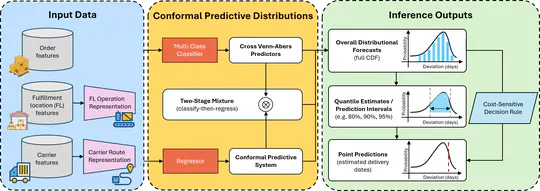
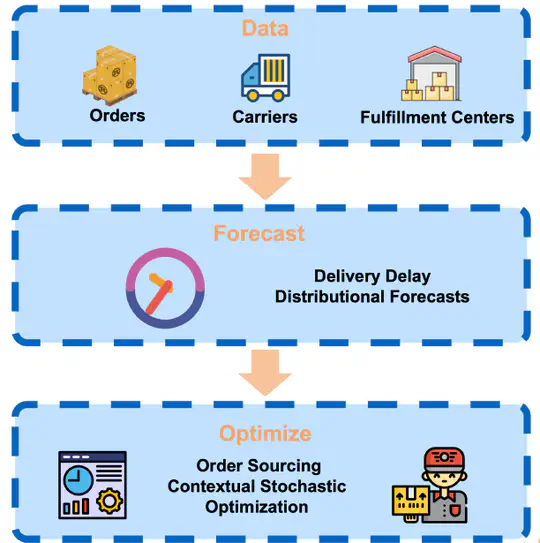
Online retailers typically decide which warehouse and carrier should fulfill each order using simple cost-minimization rules that ignore how orders could be batched together or how reliable a given carrier actually is. This paper develops a Contextual Stochastic Optimization framework that folds distributional forecasts of delivery delays directly into the fulfillment decision, tested on a real dataset with tens of thousands of products and up to thousands of fulfillment options. The framework is the first to combine multi-courier, omnichannel fulfillment with delivery-time uncertainty, and it substantially improves on-time delivery accuracy while letting retailers trade off cost against delivery risk. This work received an Honorable Mention in the 2025 INFORMS MSOM Practice-Based Research Competition.
End-to-End Supply Chains
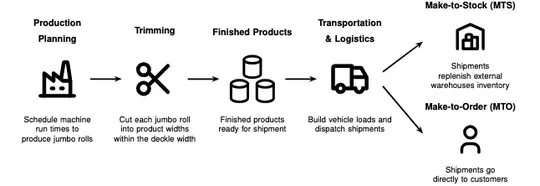
Supply chain planning problems have multiple interconnected layers of decision-making. In paper manufacturing, these layers include production scheduling, trimming decisions, vehicle loading, multi-period demand fulfillment, and inventory management. To solve the fully integrated problem at industrial scale, we develop a hybrid method combining column generation and dynamic programming for the supply-side decisions with Benders decomposition for downstream fulfillement. On real instances from a major North American paper manufacturer, the proposed approach lowers total costs by 24.4% compared to a traditional CG-DP on challenging eight-week planning problems.